Python | Панды Series.get_values ()
Серия Pandas - это одномерный массив ndarray с метками осей. Этикетки не обязательно должны быть уникальными, но должны быть хешируемого типа. Объект поддерживает индексирование как на основе целых чисел, так и на основе меток и предоставляет множество методов для выполнения операций, связанных с индексом.
Pandas Series.get_values() function return an ndarray containing the underlying data of the given series object.
Syntax: Series.get_values()
Parameter : None
Returns : ndarray
Example #1: Use Series.get_values() function to return an array containing the underlying data of the given series object.
# importing pandas as pdimport pandas as pd # Creating the Seriessr = pd.Series([10, 25, 3, 25, 24, 6]) # Create the Indexindex_ = ["Coca Cola", "Sprite", "Coke", "Fanta", "Dew", "ThumbsUp"] # set the indexsr.index = index_ # Print the seriesprint(sr) |
Выход :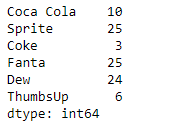
Now we will use Series.get_values() function to return the underlying data of the given series object as an array.
# return an arrayresult = sr.get_values() # Print the resultprint(result) |
Выход :

As we can see in the output, the Series.get_values() function has returned the given series object as an array.
Example #2 : Use Series.get_values() function to return an array containing the underlying data of the given series object.
# importing pandas as pdimport pandas as pd # Creating the Seriessr = pd.Series([11, 21, 8, 18, 65, 84, 32, 10, 5, 24, 32]) # Create the Indexindex_ = pd.date_range("2010-10-09", periods = 11, freq ="M") # set the indexsr.index = index_ # Print the seriesprint(sr) |
Выход :
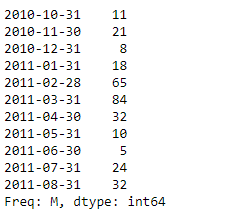
Now we will use Series.get_values() function to return the underlying data of the given series object as an array.
# return an arrayresult = sr.get_values() # Print the resultprint(result) |
Output :
As we can see in the output, the Series.get_values() function has returned the given series object as an array.
Внимание компьютерщик! Укрепите свои основы с помощью базового курса программирования Python и изучите основы.
Для начала подготовьтесь к собеседованию. Расширьте свои концепции структур данных с помощью курса Python DS. А чтобы начать свое путешествие по машинному обучению, присоединяйтесь к курсу Машинное обучение - базовый уровень.